Thursday, July 9, 2015

In Memory of Silky

Yesterday we said goodbye to Silky. At 32.5 years young she had lived a long, full life. However her body was starting to fail her, and over the last few weeks it was becoming obvious that the end was very near. 

Silky


Silky was born in Flagstaff, Arizona in 1983. She is an Appaloosa and was bred for racing, sired by Deep South and out of a mare named Go Yummer. Her registration papers have her officially named with the most unfortunate moniker of Strumming Yummer. I have never been able to look at Silky and utter the words Strumming Yummer out loud. I didn't want to offend her. Thankfully someone gave her the nickname Silky in honor of the silky texture of her mane and tail and that is how she was known most of her life.

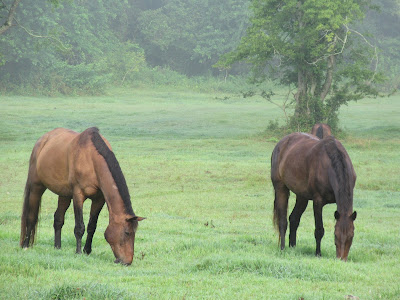
Silky grazing with friends Dolly and Lily

grazing with Traveller and Calimba


Silky spent the early days of her career at an Appaloosa race track. She sustained a back injury after just a few races that ended her racing career. She then somehow made her way to Oklahoma where she was a barrel racer for a couple of years. For reasons unknown to her mom Silky was labeled as "psycho" and "untrainable" during her barrel racing days and she was sent to an auction. A trainer from Florida happened to be attending the auction and she purchased Silky and shipped her to Florida. It was in Florida, 25 years ago, that Silky and her mom met.

Silky trotting through the pasture with MyLight and Traveller

hanging out with Cinnamon

Silky’s mom was attending summer camp at the barn where Silky was living. It was her first time being around horses and she was assigned a 30 year old mare named Star. Star was slow and bombproof and gentle, but Silky’s mom found herself drawn to another stall. The stall that everyone was warned to stay away from. This horse would kick the stall walls, charge the stall door, and snort and grind her teeth so loudly that you could hear it on the other side of the barn. This horse was, of course, Silky.

Silky


Silky’s mom began hanging out around her stall. Silky didn’t trust this new person at all but she was curious. They began to bond over their shared love of apples and carrots. Once Silky got used to this person who insisted on eating in front of her stall she started paying her some attention, and eventually Silky’s mom was able to feed her and pet her. Unfortunately the summer was over after a few weeks and Silky’s mom had to go back to school.

Silky grazing under a pretty morning sky with Norman and Lily

grazing with Dolly and Cinnamon


During this time Silky’s mom had recently been adopted, but she felt more alone than ever. After summer was over and she went back to school she acted out, badly and often. One day her father finally dropped to his knees in front of her and tearfully asked what he had to do to get her to accept him and her mom and her new life. She said she wanted Silky. Her dad called the trainer in Florida and said they wanted to purchase Silky. The trainer was opposed to it as she didn’t feel it was a good idea to match a beginner child with a difficult horse. However her father told Lynn they would pay whatever it cost in order for Silky to be properly trained, and that week Silky’s mom officially became Silky’s mom

the last picture I took of Silky, grazing with her friend Norman


A few weeks after that, Silky promptly tossed her mom into a puddle -- her first fall. As soon as she fell, Silky stopped, craned her neck to look at her, tossed her head and walked back toward the barn. She never fell off of Silky again. Silky learned how to shift herself under her weight when she felt that her young rider was off balance. Countless times her trainer yelled, “she just saved your ass kid.” They learned together and soon found themselves ranked number two in Florida for the 13 and under division on the hunter circuit.

Cinnamon and Silky

munching on hay with Calimba


During this time the family decided to move to Tryon, North Carolina to immerse themselves in the horse scene. They bought a small farm, built a couple of barns and an arena, and purchased more horses to maximize training and showing opportunities. Silky remained the "go to" horse, and after the move to North Carolina Silky and her mom changed their focus to eventing. Silky and her mom were Pony Club Rally champions. During all of their years together, both showing in the hunters and in eventing, Silky never refused a single jump. No matter how intimidating the jump was, Silky's mom said she never had to worry about Silky stopping at a jump because it simply never happened.

Silky hanging out with Cuff Links and Norman


During her time in North Carolina Silky survived a life threatening tying-up episode that everyone, including her vet, thought would lead to her being euthanized when she was only 12 years old.  Silky shocked everyone by recovering. She had several months off from riding to allow her to fully recover after that scary incident. During that time she was bred and delivered a beautiful filly that her mom named Goddess. Once Silky was ready to go back to work she and her mom returned to their winning ways. 

Silky enjoying retirement


When the time came for Silky's mom to go off to college Silky went too. After graduating from college Silky's mom semi-retired her to trail riding status. Silky was 19 years old at the time. They continued to enjoy light riding together until Silky was 25 and her mom decided it was time to fully retire her.

Silky waiting for breakfast with MyLight and Calimba

hanging out with MyLight


We met Silky about 4.5 years ago. Silky and her mom were living in Georgia at the time. Her mom was going to be moving out of the country and she was looking for the perfect farm for Silky. We were lucky enough to meet her high standards and Silky made her way to Tennessee. Silky's mom had told us that she had not been thriving at her previous barn as she was turned out with a group of young saddlebreds who were pretty rambunctious and she was ready to enjoy her twilight years. Thus we weren't expecting her to look her best when she arrived. However when the shipper unloaded her off the trailer I said to Jason, "do you think this poor mare will be with us this time next year?" Jason's response was "I'll be surprised if she's with us in six months." 

Traveller and Silky

early morning grazing with Norman

However Silky was a stubborn Appy who liked to prove people wrong. Thankfully she bonded quickly with her new group of friends. The first day Silky was out with her group she was terrified and wouldn't go near the other horses, still expecting to get chased like she had at her previous barn. Maisie, one of the mares Silky lived with at our farm, insisted on quietly following Silky around everywhere Silky tried to hide. Eventually she touched noses with Maisie, and within a few days Silky was one of the girls and part of the family. The horse that had us questioning her future proved Jason and I very wrong and proceeded to blossom. She gained weight, became very social, and generally had a great time for the last 4.5 years.

Maisie quietly telling Silky "you can run but you can't hide from me."

Over a 25 year relationship it is not surprising that Silky had earned a variety of nicknames from her mom through the years. Some of her nicknames included The Woo, Woosa, Happy Appy, Appywoo, or simply Woman when she was being testy.  Silky loved apples and would beg for a treat by holding up a front hoof. She loved sunbathing, and she loved grooming and hanging out with her friends at our farm. She also made it known to all involved each year that she hated the dentist.

grooming with Norman


grooming with Traveller


grooming with MyLight


Sadly we said our goodbyes to Silky, AKA The Woo, Woosa, Happy Appy, Appywoo, and Woman, yesterday. After 32.5 years of living life largely on her terms her body was physically starting to fail her. We said our goodbyes under the shade of a giant old tree by her pasture with her friends watching on the other side of the fence. After the vet sedated her and began to administer the euthanasia solution, Silky left this world before the vet had injected half the solution. She was ready to go. We will miss her, rest in peace Silky.

enjoying retirement with Dolly and Lily


Tuesday, July 7, 2015

Too Much Experience

We had the misfortune of dealing with a couple of water leaks right at Christmas. It was really a great way to spend the holiday week (that was said with sarcasm). We found ourselves dealing with another water line leak yesterday. Of course, per usual, Jason did 95% of the misery work associated with repairing the leak. To say he was not happy about the situation would be putting it mildly. At this point we would both agree we have too much experience in this area. Even I'm beginning to think I could repair a leaking water line and that is scary.

The part that has him the most upset is the fact that all three of these leaks have occurred in the only section of all our water lines that he didn't install himself. We have several thousand feet of water lines at the farm, most of them installed by Jason. When we were at the peak of our farm building frenzy we decided to pay someone to install about 1,000-ish feet of water lines for us. Sometimes you have to admit that you can't do it all. It goes without saying that Jason deeply regrets that decision now. The good news is that Jason installed shut-offs at every pasture and every trough. So we can shut off the water only to the area with the leak and still have water at the rest of the farm. Jason thought his water lines through very well and that has paid off.  Having someone else do some of the work definitely has not paid off.

After five years that entire section that was not installed by Jason appears to be slowly failing. We've now had three leaks in it in the last 7 months. Jason made phone calls today to see about getting someone with a backhoe out to the farm in the next couple of weeks to dig up all of those lines. Instead of being surprised with a leak at random times we're just digging up and replacing all of the lines in that 1,000-ish foot section. We are not happy (understatement of the year) about the time, the expense, or the pain in the butt factor that will be associated with this but it seems to be the most prudent choice.

The only positive thing Jason managed to say yesterday was that it is a lot easier to repair a leak when it is warm and sunny then when it is 45 degrees and raining. My back hurt just watching him dig. So I guess our Christmas in July present to ourselves will be replacing 1,000+ feet of water lines. As anyone would be, we are totally thrilled.

________________________________


I think Jason would have been pleased with less supervision and more helpers


Having a farm is always fun


MyLight, Calimba and Dolly


Walden and Fabrizzio


O'Reilly


This visitor was waiting for me when I went to the back barn to feed one morning. He immediately jumped in the back of the truck and expected me to drive him around. Thankfully Jason found his owners who were actively looking for him.


Nemo


Toledo and Kennedy


Lightning waiting for breakfast


Duesy and Bruno hanging out before breakfast


Lofty and Donneur


George and Gibson


Gus, Silver and Cocomo

Sunday, July 5, 2015

Sunday Stills


River, Rubrico and Oskar


Tony and Thomas


Ritchie


Foggy morning pictures; Renny


Mick


Taco


Mick and Renny


Taco, Renny and Mick having a 3-horse grooming session


herding mares and ponies in for breakfast; Traveller, Silky, Cuffie, Lily, Calimba, Cinnamon, Norman and Dolly


Norman and Silky


2.5 inches (6.3cm) in the rain gauge this morning, and Jason had dumped an additional inch (2.5cm) out yesterday. I'm happy for all the rain but it would be great if the rainfall could spread itself out over more days. It would be a lot more useful that way.


this section of our creek is normally dry this time of year but 3.5 inches of rain (almost 9cm) has it flowing nicely for a few days


Maisie and Traveller


Cuffie and Norman


Merlin and Duesy


Thursday, July 2, 2015

Cushings/PPID Primer, Part II

Welcome to Part II of the Cushings/PPID primer. If you have not already read the first post on this subject it would be very helpful to read it first before continuing with this post. You can find Part I of the Cushings/PPID primer here, and in that post I explained what Cushings/PPID is. I also want to emphasize again that I am grossly oversimplifying my explanations in order to make the big picture easier to understand. This series of posts will not be submitted to a veterinary journal.

Now that we know what PPID is how do we recognize the signs? As I mentioned in the first post there is a lengthy list of signs that can point to PPID. Many of them are easily attributable to other causes so it is easy to to miss the early signs of PPID. I also find that when these signs are seen in younger horses people often do not want to test because in the past PPID/Cushings has always been thought of as an "old horse" disease. This assumption is patently false. It has now been clinically proven that PPID can occur in horses as young as five years old. 
This meme makes me giggle. As soon as I tell someone I think their horse should be tested for PPID (or any other disease) the emails with all the internet theories often start.  I understand why, I've presented my small animal vet with a lot of internet theories. The problem with internet theories in regards to PPID is that a lot of old theories about PPID in horses have been shown to be false (hence the name change in horses from Cushings to PPID). Thus, much of the information someone is reading on the internet is not current, even articles from vet journals that are only a few years old. The irony that I am posting this picture on the internet with some information about PPID is not lost on me.


One reason that PPID was thought of as a disease only for older horses was the lack of a test sensitive enough to give a positive result if PPID was still in the early stages in a horse. It wasn't that many of the younger horses that tested negative for PPID didn't actually have the disease, it was simply that there was no test sensitive enough to diagnose them, and many would maintain there still isn't a test sensitive enough. As one of our vets once said, the tests we have for PPID don't give us a positive result until the disease has essentially reached Stage 4 cancer in many horses.

For us, the most common sign that tips us off that a horse should be tested for PPID is abnormalities with the haircoat. The hair doesn't shed properly, the horse sheds very late, the hair is very long and dry, or maybe all of the above. The second most common symptom we see is excessive water consumption. We've had more than one horse whose only sign of PPID was their constant trips to the water trough. Their coats looked good, they had shiny hair, they shed normally, but they drank an excessive amount of water. Other symptoms we've seen have included muscle loss, abnormal fat deposits, excessive sweating and/or abnormal sweat patterns, lethargic attitude and symptoms one might associate with a suppressed immune system such as chronic skin issues or runny eyes. Laminitis is also a common symptom of PPID although it isn't one we've dealt with.

Maybe you have noticed that your horse is exhibiting one or more of these symptoms. What should you do? Call your horse and get them tested for PPID by your veterinarian. But before you do that have an understanding of the tests that a vet might choose to use. There are some tests even older than the ones I discuss below, but for the most part any vet is going to mention one of the following three tests.

1. The DST or Dexamethasone Suppression Test - In the dex suppression test blood is drawn to measure blood cortisol levels. The horse is then injected with dexamethasone and blood is drawn again 19 hours later to measure cortisol levels. A normal horse should respond with a very low blood cortisol concentration after injection of dexamethasone. This is due to negative feedback whereby high circulating levels of steroids (from the dexamethasone) signal the body to suppress the release of cortisol. Horses with PPID lack this normal response and will continue to have normal to elevated cortisol concentrations (failure to suppress).

There are a lot of weaknesses to the DST. Number one is the test cannot be accurately performed during the fall because cortisol levels in the horse are naturally higher at that time. Also the test is not sensitive and will give false negative results in early onset cases. If this is the only test your vet is using to diagnose PPID at this time then they are not current on diagnosing PPID.

Negatives aside this test was used for a long time because it was the test we had. Then the baseline ACTH test came along. However it could only be done during certain times of the year at first. Thus, depending on the season horses were tested using the DST or a baseline ACTH test. We no longer use the dex suppression test test at our farm.

2.  Baseline ACTH Test or Plasma ACTH Concentration - These two terms are often used interchangeably to describe the same test. For a baseline ACTH reading your vet will draw blood in EDTA (purple top) tubes. The blood is chilled then the plasma is separated from the blood cells and sent for testing. 

In horses positive for PPID the plasma concentration of ACTH is considerably higher than in non-affected horses. For a few years there wasn't enough reference data to perform the ACTH test year round. Thankfully that eventually changed and the test can now be done at any time of the year. In our experiences we saw fewer false negatives with this test as compared to the Dex Suppression Test. However we still had horses with negative results to this test that showed clear clinical signs of PPID. 

3.  TRH Stimulation Test (our test of choice) - TRH stands for thyrotropin-releasing hormone.  To perform the TRH stim test your vet will first draw blood to measure baseline ACTH levels as described above. Your vet will then administer TRH via IV injection, wait ten minutes, and then collect another blood sample that will be used to measure the post-TRH level of ACTH. Thus you get two ACTH levels with this test, a baseline reading and a post-TRH reading.

In our experience the TRH stim test appears to be the most sensitive test for PPID available at this time. Horses at our farm that have presented with a negative result after a baseline ACTH test have tested positive using the TRH stim test. Thus, this test is our test of choice at this time. The big drawback is that, just like it used to with the baseline ACTH test, there is currently only enough reference data to perform this test in the months of December through June. Outside of those months we have to settle for the baseline ACTH test, and if we get a negative result will retest using the TRH stim test during the December - June period.

Researchers in the field of PPID freely admit that there is still not a test sensitive enough at this time to pick up many of the early stage cases of PPID. Thus, if your seven year old horse has clinical signs and a negative test, he probably has PPID. This theory has been proven true through necropsies of young horses with clinical signs but negative tests. 

What happens if your horse does test positive for PPID? I'll cover that in my next post on the topic.

_______________________________


Apollo and Hemi


Asterik and Gus


Homer and Levendi


Mick and Lighty


Moe


Rubrico


Grand, Elfin and Rip


Hesse, Remmy, Duesy and Merlin