Thursday, January 16, 2014

Blanket Review

I have to say from a blanket repair perspective I am not loving this winter at all. Of course I don't like, and especially do not love, winter to begin with but this one is really starting to wear on my nerves. The horses have been in sheets or blankets more this winter than the last two or three winters combined.  Normally I love to stand and watch horses being playful and having a good time. When they are wearing their blankets I am wincing with every bite and grab while thinking "Don't grab the blanket. No, don't grab the blanket!  LET GO OF THE BLANKET!" as they are horsing around.  They rarely never seem to pick up on my thoughts even though I am shouting them in my head.

Thus far this season I have stitched rips and tears in:

1 regular Centaur turnout (not a Turbo 1000)
1 Rhino turnout
2 Big D turnouts
1 SmartPak turnout (I should point out this was not one of the new SmartPak ultimate turnouts)
1 Saxon turnout
1 Weatherbeeta turnout
1 Pessoa turnout

one stitched up Rhino


I actually left this Centaur blanket on the horse while I stitched it. I put a feedbag on Johnny and he stood there and ate while I stitched. I made three more passes after I took this picture in the hopes that my patch job will last until the end of the season. As I was doing this I was trying to decide if I was brilliant or stupid for doing this with the blanket on the horse. It worked so I am going with brilliant although I probably won't choose this repair method again.


One repaired SmartPak blanket; I use a heavy needle and dental floss to do these temporary blanket repairs.


I had to do a small repair to this Big D blanket near the withers


About half the horses here are outfitted with Rambo blankets and the rest with various other brands. I  feel the need to point out that I have not yet had the need to stitch up a tear in a Rambo this season while I am busy sewing away on many other brands. The Rambos are not infallible and they can have their issues as well, it just happens a lot less often. Whenever anyone asks me what blankets I recommend I always say Rambo. Yes I know they are expensive blankets. But they also last, can take a lot of rough horse play, and stay waterproof. We get several years out of the Rambo blankets with no spotty waterproofing.  Sometimes people say they think their horse needs shoulder gussets because they have big shoulders. Buy the Rambo with leg arches, I promise they work better to free up more room than the shoulder gussets. 

Between blankets and sheets I deal with well over 100+ blankets. I watch how they hold up and if the waterproofing lasts. These blankets are being worn in group turnout and some of the horses play hard. The most important criteria I have for a blanket is that it stays waterproof. Hands down the blanket that can stand up to the abuse the best and stay waterproof is the Rambo. My second place choice is the Centaur Turbo 1000 (not the regular Centaur). They are not quite as tough as a Rambo but they are close and they maintain their waterproofing.  I am also a fan of Bucas blankets.

Another thing I have learned to hate about blankets is any blanket that has leg straps instead of a tail strap. Anytime a horse has had an "incident" with a blanket it has always involved a leg strap. I detest blankets with leg straps. In my vast personal collection of blankets (and I am a self proclaimed blanket 'ho) I do not own a blanket with leg straps. Let me reiterate that. I do not own a single blanket with leg straps. After spending years watching horses wear turnout blankets outside in group turnout I will not buy a blanket with leg straps. They are an accident looking for a place to happen. So far, thankfully, I've yet to see a horse truly hurt in a leg strap incident but it is only a matter of time. I may be forced to break my own rule in order to get a blanket for Timbit that actually fits him correctly, and I just cringe at the thought of buying a blanket with leg straps.

There are a few problems with leg straps. They get caught on things more easily than a tail strap. And although tail straps get caught on things as well they also tend to just pop off easily or break whereas the elastic leg straps stretch first and don't break as easily so they tend to stay caught. The leg straps also lose their elasticity. One day the strap is fine and the next day the strap is ten miles long and basically dragging on the ground while still properly snapped at both ends. I have lots and lots of leg straps with  multiple knots tied in them trying to remedy this problem. Unfortunately it simply is not realistic for me to go out and buy 100 or so pairs of leg straps and replace them all each year in the hopes of keeping them from stretching.

If you must (although I wish you would not) buy a blanket with leg straps the Dover Northwinds are my top choice there. These are good, sturdy blankets that hold their waterproofing for a few seasons and can take some rough horse play. My second choice for a blanket with leg straps would be Pessoa blankets. Really my main complaint with either of these blankets are the fact that they have leg straps. 

Big D turnouts take a lot of babying to get them through one season to the next. The denier of the fabric is only 600D so they are constant victims in group turnout. The drop on the saxon blankets is very short, I swear some of them look like mini skirts. The Weatherbeetas seem to lose their waterproofing after a couple of seasons and get their share of rips. Although the Schneiders blankets tend to wear very well the waterproofing on them is the pits. I have had more than one Schneiders blanket not be waterproof right out of the bag. If you do get a Schneiders that is actually waterproof, I have found that the first time you wash it you can say goodbye to some or all of the waterproofing. So none of the Schneiders blankets get washed, they only get cold water rinses.  I am so unimpressed with the waterproofing on Schneiders blankets I have started specifically requesting that people not send them. It is a shame since they are tough blankets, but it doesn't really matter since the waterproofing is so questionable.

I can summarize this post by saying buy the Rambo (or buy the Rhino or Amigo knowing you will need to replace them after a couple of seasons). Feel free to buy a Bucas or a Centaur Turbo 1000 but I would still prefer the Rambo. Just say no to the leg straps. If you cannot help yourself then buy the Dover Northwind or the good Pessoas.  Please do not send a Schneiders.  

In closing, in case I was not clear enough, buy the Rambo, or the Bucas, or the Centaur Turbo 1000.

________________________________


Johnny and Lighty were having a grand time . . . 


. . . still going at it . . . 


. . . totally ignoring me as I was screaming "don't grab the blanket!!!!"  One Centaur blanket was harmed in the making of this picture. . .  
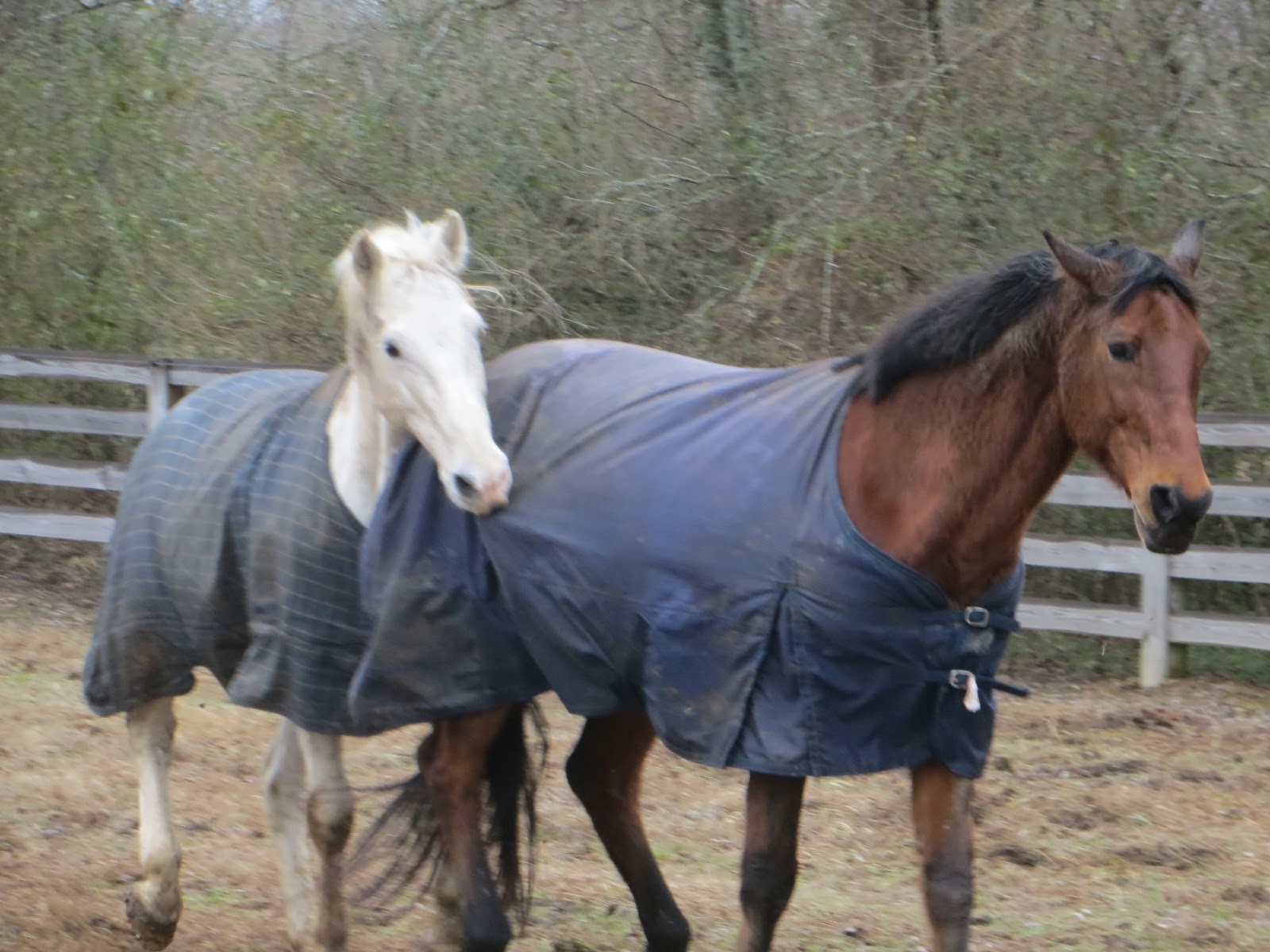

. . . what is one rip in a blanket when you are having this much fun?


Cocomo, Flyer and Silver


the sunrise had lots of pretty colors again this morning


Donneur
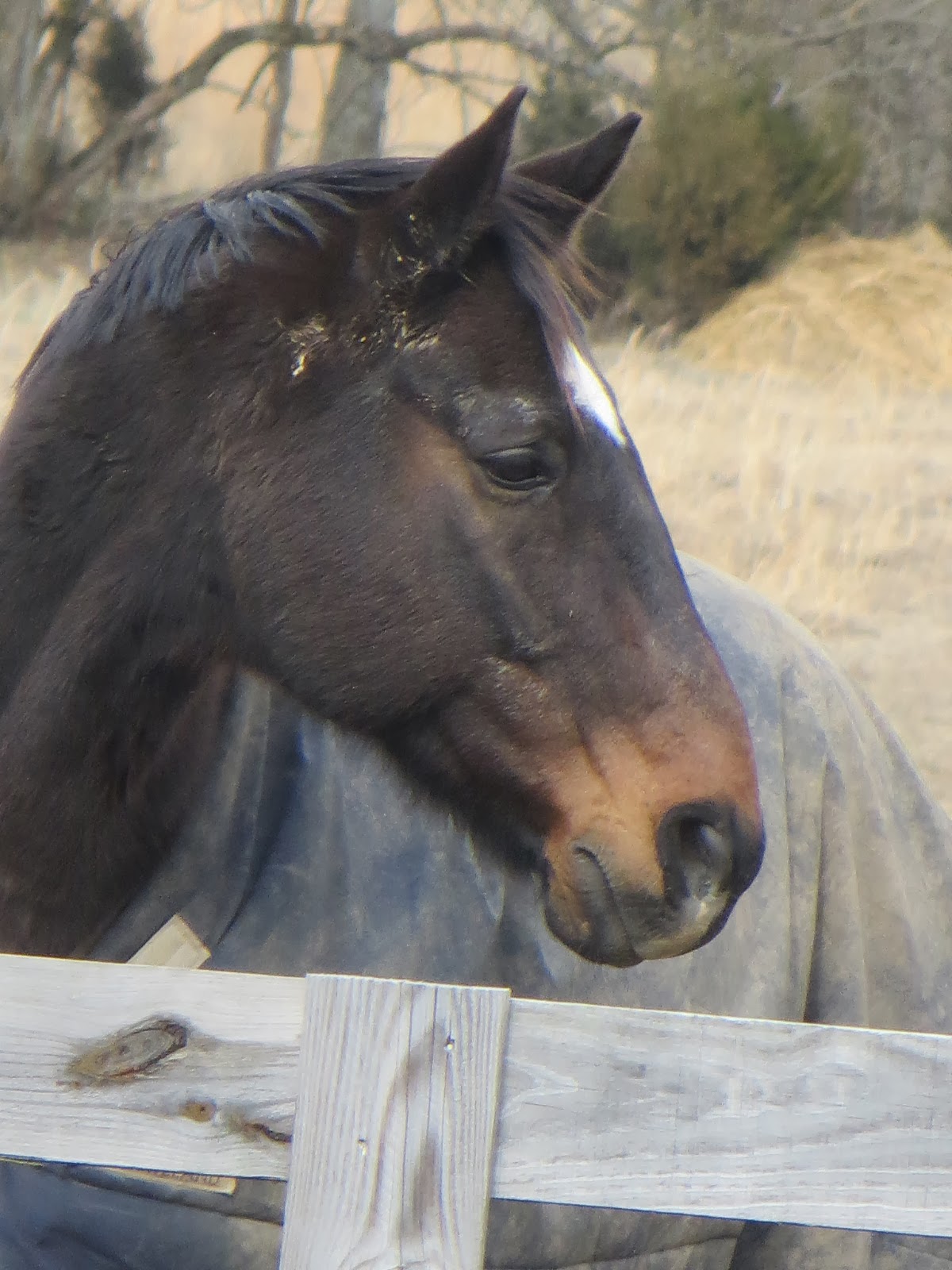

Timbit and Sparky have become big friends. They play a lot . . . 


. . . Timbit getting ready to fire with the hind leg . . . 


. . . I like Sparky's expression here. He looks like an alpaca


Gibson and Lotus were watching Sparky and Timbit play


neither Baby or Elfin could be bothered to look at me
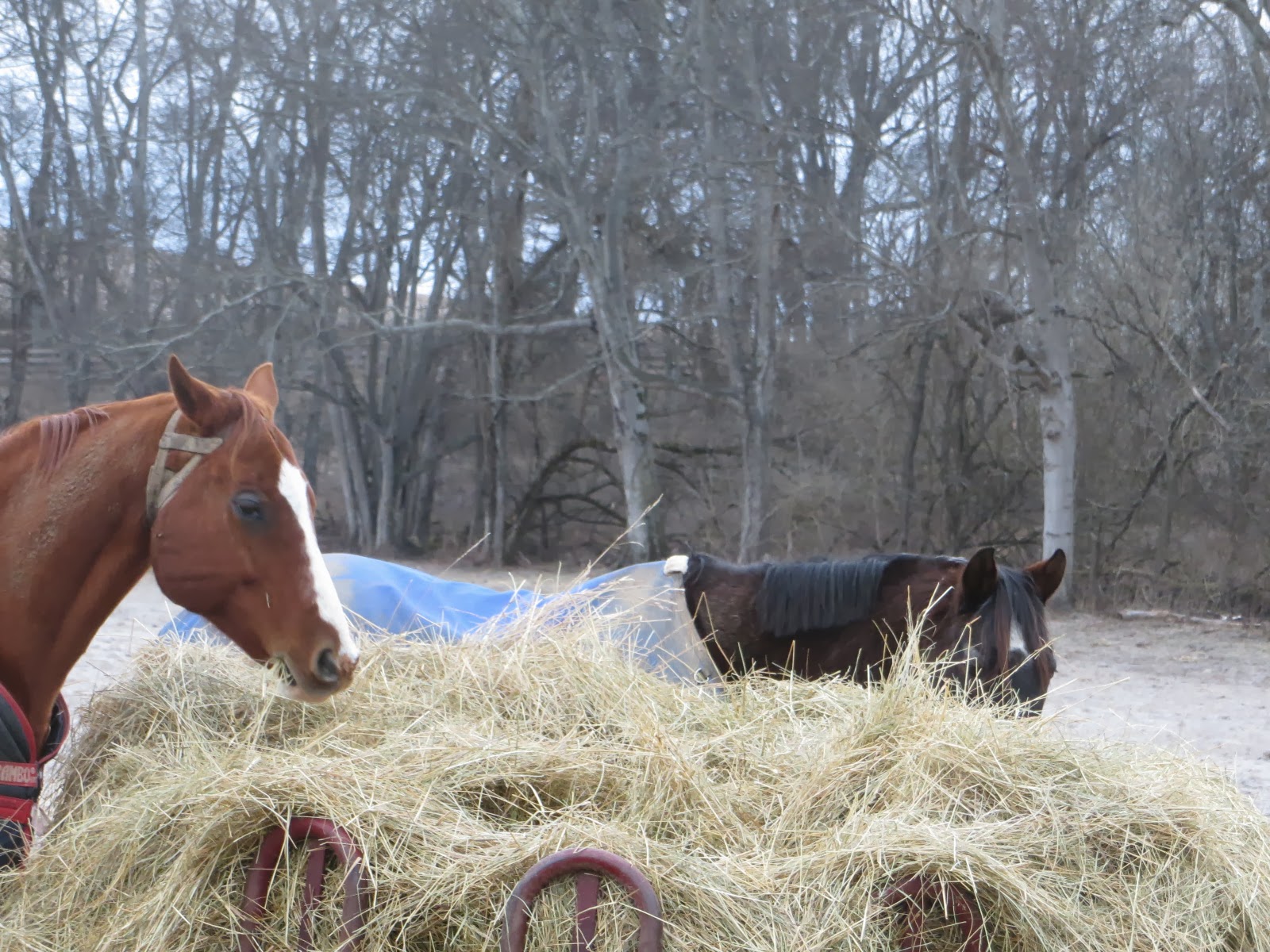

Dutch and Renny napping in the afternoon sun


Darby

Tuesday, January 14, 2014

Farm Case Study

(post by Jason) A few weeks ago I did a series of nutritional consultations involving ration analysis and some troubleshooting at a large equine facility located in the mid South. What I found was interesting so I thought you might enjoy reading about it here on our blog. As always, the name of the clients and facility is being withheld to protect their anonymity.

Background

The clients have roughly 80 horses all of whom are on half day turnout with the remainder of their time being spent in stalls. The turnout paddocks are clean and large and the horses have free choice access to round bales of moderate quality grass hay. They are on average eating 5-7 lbs of this hay during their relatively short turnout. The grass was very lush in these paddocks all summer long.

The horses were eating roughly 18 lbs straight alfalfa hay broken into four feedings over the course of the 16-20 hrs per day they spend in their stalls. They were also getting roughly 1.5 lb beet pulp soaked at their afternoon feeding. Additionally they were getting a vit/min supplement made on the west coast, some Epsom salts and grain 2X per day at a max of 3 lb per feeding. The clients did not know anything about the energy content or starch/sugar level of this grain. The stalls all had automatic waterers that measured water volume. Horses drinking less than 5 gallons per day in the winter had buckets added to their stalls.

The horses had been de-wormed when fecal parasite load showed it was necessary which meant some horses were being de-wormed a few times per year and some not at all. 

When we had a look at body condition score the average was quite high; most of the horses were overconditioned and a few were obese. There were no skinny horses on the property. The clients had seen several gas colics; all but one resolved with minimal veterinary assistance. These clients were adamant they did not want to make a change away from alfalfa hay but were open to changing nearly anything else. Their goals were to keep their feeding program as simple as possible and focus on providing excellent quality forages with minimal energy and mineral supplementation.

Results

The very first thing I did was send away a sample of their alfalfa hay for analysis. A copy of the analysis is shown below. My first ration analysis was to evaluate their current forage feeding program to see where they stood from a nutritional perspective. After identifying what they were doing my second ration analysis would fix whatever problems I uncovered while staying within the parameters outlined by the clients.

Copy of hay analysis; click to enlarge


Unfortunately, horses don’t eat percentages so the first thing I did was convert all the figures above into pounds of nutrients. I did this by multiplying the percentages in the as fed column (first column) by the number of pounds of this forage (18) that the horses are currently eating. I then compared my nutrient analysis to tabled values for horses roughly the same size and in roughly the same body condition as those of my clients. My findings are listed below:

1. Total crude protein levels were extremely high. This is not an abnormal situation where alfalfa is concerned. Extra protein is processed in the liver and kidneys and is excreted as urine. Making the liver and kidneys work extra hard over a long period of time is almost certainly setting certain horses up for future metabolic disorders. 

2. Ration Energy levels were also quite high and the NSC of the grain they were feeding was off the charts at 66 %.  

3. Ca and K levels were quite high while Mg and P levels were reasonable. This was exactly what I expected to see with alfalfa hay.

4. On the trace mineral side iron was very high while zinc, copper and manganese were all low/deficient. When I plugged in the trace mineral values from the client’s vit/min supplement it became clear very quickly that this was not the right product for an alfalfa based diet.


Recommendations

1. De-worm on a more regular basis. De-worming according to fecal parasite load is fine when horses spend nearly all their time in stalls and/or are on single turnout in a paddock that *isn’t* shared with other horses. Even then, if you aren’t regularly sampling every horse’s manure…ie. several times a year… it’s easy to have a few develop large parasite loads while everyone else is fine. Additionally fecal testing cannot identify certain types of parasite loads such as encysted strongyles and tapeworms.  Thus it is my opinion that every horse ought to be de-wormed at least twice per year with a product that can address tapeworms and encysted strongyles.

2. The clients should seriously think about switching forages. Although alfalfa is energy dense it is severely oversupplying protein in this diet. The other problem is that the horses are not meeting gut fill requirements with this forage as is seen by their consumption of moderate quality grass hay while on turn out. Horses are not designed to have empty guts.  It would be my recommendation to switch to a good quality grass hay. This would more closely match equine protein requirements with what is on offer from the ration while maintaining an excellent energy profile and a mineral balance much more suited to equine digestive systems.

3. The client should seriously consider changing grain sources to something (anything) with a more reasonable NSC/starch/sugar profile. I told her to come and visit our large retirement farm if she wanted to see what high NSC grain feeds do to horses. We have many horses that came to us from a similar feeding program and they often arrive with a history of Insulin resistance and laminitis. Their owners will be happy to tell you that these are expensive and time consuming to treat and they are often a direct result of feeding forages and grains that are extremely high in starch in sugar.  

4.  If the clients are going to continue feeding alfalfa hay then they should definitely feed an alfalfa ration balancer instead of the vit/min mix they were currently feeding. I recommended a couple of good commercial options.

5. Epsom salts are mostly a combination of magnesium sulfate and potassium sulfate. Since neither of these minerals were limiting and in fact potassium levels were very high I recommended the clients discontinue feeding Epsom salts immediately.

6. The clients were worried about the number of gas colics they were seeing. Gas colics can  be caused by so many things that one is almost never able to define a single causative agent that when remedied eliminates the problem. However there is absolutely nothing to lose and possibly much to gain from reducing the cumulative stressors we put on our horses. In this case reducing cumulative stress, at least from a nutritional perspective, would best be accomplished from following the recommendations listed above.


It will be very interesting to do a follow up with these clients in several months to see what changes they’ve implemented and to see the results of their dietary and management changes. It’s rewarding to be able to take my life experiences and offer sound long term independent solutions to their farm management and nutritional challenges.  
____________________

Grand


Merlin, Lightning and Lucky waiting for breakfast in the fog


Rip and Levendi


Gus wondering just how far George could shove his head into the hay (apparently his entire head!)


Lotus, Romeo and Lofty


O'Reilly showing off his elf ears


Walon and Largo


Toledo, Clayton and Rocky 


Sunday, January 12, 2014

Sunday Stills


Cocomo and Lofty


Faune and Flyer


Tony and Leo


Kennedy and Bergie


Sebastian and Lighty


Renny, Johnny and Murphy


Norman, Cuffie and Silky


Darby, Alex and B-Rad


Timbit, Miracle, Sparky and Griselle

Thursday, January 9, 2014

Emergency Over

We survived. The weather system has moved on to torture some other poor souls and our state of emergency has officially ended. Of course it actually ended on Monday evening but TEMA (Tennessee Emergency Management Agency) still insisted that we were all going to die anyway if we went outside. Mid-morning on Wednesday the thermometer crossed the freezing threshold and Tennesseans everywhere were rejoicing and singing hallelujah. By Wednesday afternoon it had reached 42 degrees and everyone in the state was running around in shorts.  Actually we weren't but we at least felt like we had returned to some semblance of normalcy. 

TEMA announced the news that the state had survived 60 continuous hours under the freezing mark. We have heard over and over how amazing this is.  TVA (electrical system) announced that they had the highest usage ever recorded on Tuesday as we all tried to keep our homes heated.   Our lowest temperature at the farm was Tuesday morning with a low of 1.7 degrees. 

During all of this the only time I felt I was truly in a state of emergency was when I needed to go the bathroom. When you wait until the last possible second to pee and you find yourself having to pull down your jeans and three layers of long underwear with frozen fingers . . . it is safe to say that was a real state of emergency.

Our tractor battery is no longer in our house hanging out with the other food items in our pantry. Jason reunited the battery with the tractor on Wednesday morning after the thermometer had crossed the freezing mark. After putting the battery back in the tractor Jason had a moment of silence and then, with some trepidation, turned the key to start the tractor. It came to life immediately.  Jason did a celebratory fist pump and looked like he had just won a gold medal at the Olympics.  He continued to revel in his glory today after he was on the tractor for awhile moving feed around and refilling hay feeders. After he was done with the tractor he told me for the 37th time me how brilliant he was for having the foresight to bring the tractor battery into the house.

I made the mistake of saying we did not really know if bringing the battery into the house accomplished anything since we waited until it had warmed up to start the tractor anyway. This was definitely the wrong thing to say.  I was told clearly that I know nothing about tractors, and in particular nothing about our highly temperamental Ford tractor (and it is highly temperamental).  Since I have no immediate plans to improve my knowledge on this topic I bow to Jason's authority that the battery living in our house saved the day. 

We no longer have any double (or triple!) blanketed horses. Everyone has on one blanket and most of those are rain sheets. I shall do my best not to complain about the rain this weekend and instead appreciate the fact that the air temperature is well north of the freezing mark. 

_____________________________________


Jason reuniting the battery with the tractor


Fabrizzio and Merlin were very relaxed while waiting for the farrier


Walden was convinced Jason had food in his pocket . . . 


. . . but it was just a phone. Walden wanted to try and eat it anyway.


Noble was looking relaxed in the sunshine


Sam doing his "that was sooooo good!" routine with his tongue after eating


Wiz hanging out


Darby, Alex and Dutch


Homer and Ritchie


Levendi and Apollo


Calimba


Toledo, Johnny and Walon enjoying their patch of green rye grass